Remembering Wendell Berry
September 18, 2026 Roots of ChangeWith Wendell Berry’s passing an avalanche of great remembrances have been published. They are heartfelt and stirring because he opened hearts, and he also opened minds. He was the great farmer-poet-philosopher who has tried to awaken our hubristic nation to the price we will pay for destroying the agrarian communities that are the source of life-giving food, but also of a groundedness needed to keep us in touch with the ecological and economic realities underpinning civilization.
If you have not already, I urge you to read Wendell Berry. His poetry, novels and essays make the case that we must reinvigorate rural communities, not out of charity, but out of rational understanding of what it is required to sustain a people, our people, and the individual soul. Next year will mark the 50th anniversary of the publication of his seminal work, “The Unsettling of America: Culture & Agriculture.” In it, he argues that the future of the nation is imperiled by the abandonment of rural communities, and the resulting destruction of rural culture. That culture is the font of our national existence because humans, in fact the existence of all life, is based on our dependence on the natural world.
My favorite book of Wendell’s is “The Memory of Old Jack.” I love this novel because it reveals the simple but profound connections among people that are born of shared struggle and shared commitment to caring for land and community. Such connections foster loving bonds. Like all of us, Old Jack is an imperfect person. But his integrity and willingness to look reality in the face about himself and others, as well as his willingness to aid those in his community make him beloved.
In early 2008, Roots of Change initiated and managed the creation of the Declaration for Healthy Food and Agriculture that was unveiled at the Slow Food Nation event that September in San Francisco. Roots of Change enlisted author Dan Imhoff as our editor in the drafting process and reached out to many of the great minds of that time focused on food system change. Wendell was of course among them. We sent a paper copy to him of a near final draft. He wrote back by hand with edits on our document. He informed us that we had used an “ugly turn of phrase” in one section. He also urged us to frame the Declaration for a healthy system as a God-given right, not something to be granted by a higher authority. We altered our framing and cleaned some language and Wendell agreed to sign the Declaration. The final document was read aloud on the grand staircase of City Hall in San Francisco on the opening day of the three-day event that attracted nearly 60,000 people to learn about Slow Food’s concept of “good, clean and fair” food. A clip of the reading ended up on a segment of the news show 60 Minutes and The New York Times mentioned the Declaration in a page one article about the event. Slow Food Nation marked a change in how the media covered the movement to fix food. The food system became part of America’s national discourse.
I know from my conversations with his daughter, Mary Berry, leader of The Berry Center, that at times Wendell felt his efforts to awaken the nation had not borne fruit. But I think this notion will be proved wrong. He was simply far ahead of the nation. Perhaps you too sense that we are on the verge of great uncovering of reality. Climate chaos, economic decline, global conflict fomented by massive egos, and the corruption that surrounds us are revealing our collective hubris. As countless myths and histories of the world reveal, hubris brings a fall. When ours comes we will then face facts and Wendell’s warnings will be seen as prescient; his thinking, rational. His soulful writings will help guide us into a new paradigm around food, culture and economics.
Wendell Berry’s writing reflects that we humans are resilient. We do cooperate when the going gets tough. So I take heart. There will be pain, but we are learning, and we are finding a better way to organize our food system as the basis of civilization. Wendell is gone, but his work remains with us and we will always remember him.
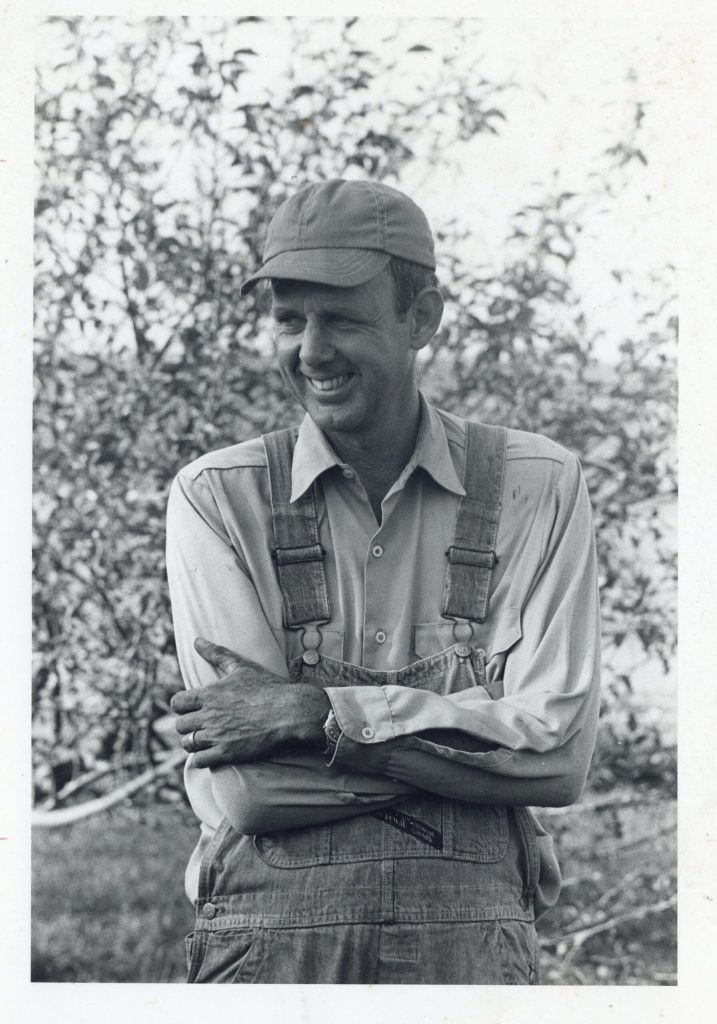
Image: Wendell Berry at home ca. 1960. (Photo credit: James Baker Hall via The Berry Center)
agriculture, culture, Declaration for Healthy Food and Agriculture, Wendell Berry